Improving circuit efficiency through targeted mica recovery. Nasaco test work compares the selective amine collector Nascol CZZ1 with EDA in the mica prefloat ahead of spodumene flotation.
The challenge of selectivity in spodumene flotation
Typical pegmatite ore consists of spodumene (LiAl(SiO3)2) with the gangue minerals quartz, feldspar and mica. A fatty acid is used to recover spodumene; however, this collector also floats mica. To manage this, operations rely on a preflotation stage, where mica is removed using an amine collector ahead of spodumene flotation.
In practice, however, conventional amine collectors used in the prefloat are not selective. They recover not only mica but also significant amounts of quartz and feldspar. An amine that is selective towards mica in the prefloat could therefore be beneficial for the following reasons:
Reduced mass pull
Potentially lower spodumene losses
Reduced potential amine carryover into the spodumene fatty acid circuit
This study evaluates the performance of a selective amine collector, designed to preferentially recover mica while limiting flotation of other gangue minerals.
A more selective approach
Flotation test work compared a novel amine-based collector (Nascol CZZ1) with a conventional amine (EDA). Tests were conducted on a representative lithium-bearing ore using standard rougher conditions (pH 2.5, 10-minute flotation, 2.5 L Denver cell), across a range of collector dosages. The results highlight a clear shift in selectivity.
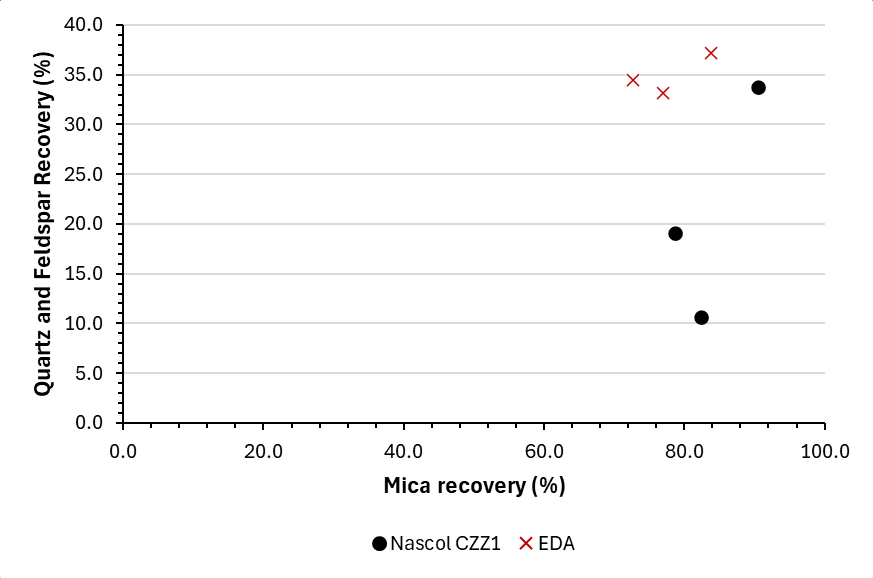
Figure 1: Relationship between quartz and feldspar recovery and mica recovery at pH 2.5 for Nascol CZZ1 and EDA. Points illustrate recovery at 100 g/t, 200 g/t and 300 g/t.
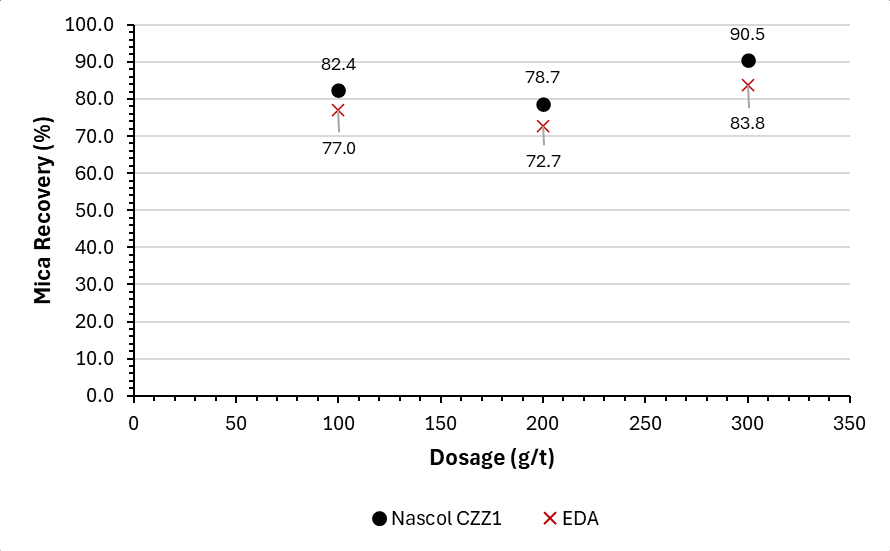
Nascol CZZ1 consistently improved mica recovery by approximately 6% relative to EDA. Notably, the mica recovery achieved with 100 g/t of Nascol CZZ1 was comparable to that obtained with 300 g/t of EDA. This improved efficiency at lower dosage offers a potential cost advantage and reduces the risk of amine carryover into the downstream fatty acid circuit.
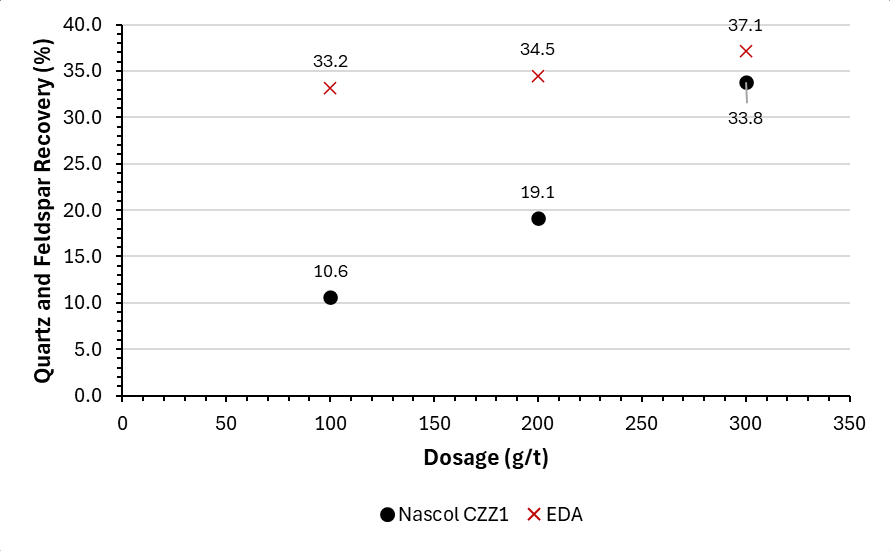
Importantly, this improved recovery did not result in increased quartz and feldspar recovery. Quartz and feldspar recovery were significantly reduced across all dosages (by up to 22% at 100 g/t). This demonstrates that the reagent preferentially targets mica while limiting the recovery of quartz and feldspar.
Figure 2: Muscovite recovery as a function of collector dosage at pH 2.5 for Nascol CZZ1 and EDA.Figure 3: Quartz and feldspar recovery as a function of collector dosage at pH 2.5 for Nascol CZZ1 and EDA.
Impact on spodumene losses in the prefloat
The benefit of improved selectivity becomes evident when considering spodumene losses in the mica prefloat.
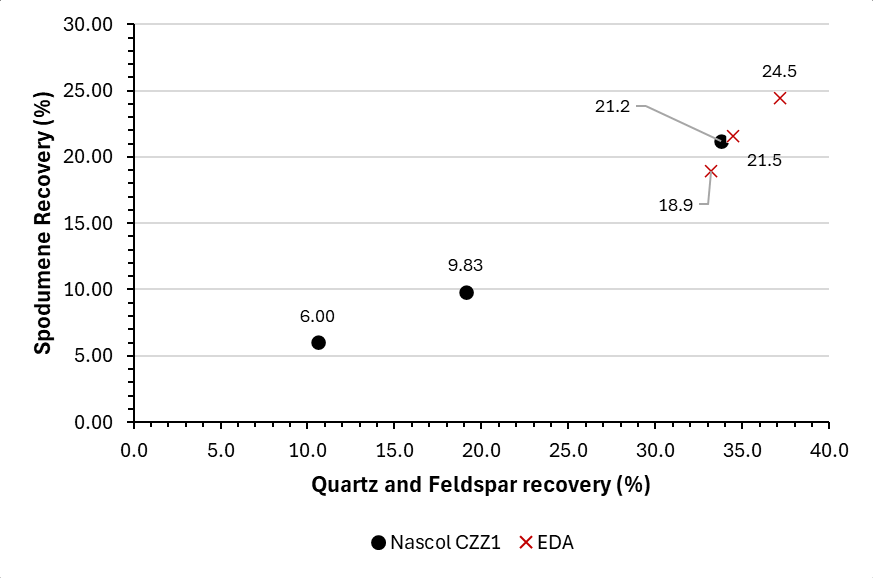
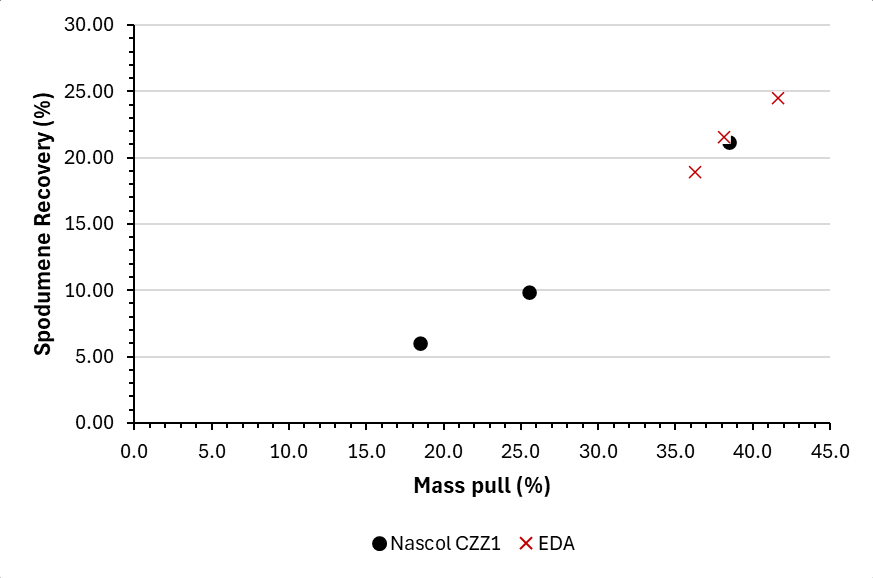
A strong relationship was observed between quartz and feldspar recovery and spodumene reporting to the prefloat. Figure 6 demonstrates that spodumene recovery is largely due to entrainment and entrapment. Limiting quartz and feldspar recovery lowers mass pull, reducing the amount of entrapped spodumene particles.
Due to this relationship, spodumene losses in the mica prefloat are approximately 13% lower than with EDA at 100 g/t.
Figure 4: Relationship between spodumene recovery and quartz and feldspar recovery at pH 2.5 for Nascol CZZ1 and EDA. Points illustrate recovery at 100 g/t, 200 g/t and 300 g/t.
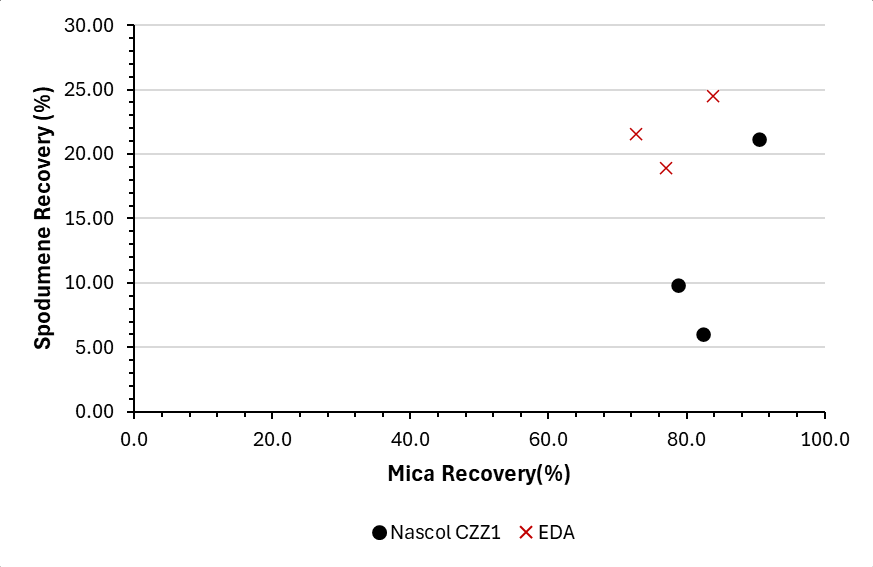
This improvement has important downstream implications. Cleaner performance is sensitive to both solids loading and the amount of value mineral that needs to be recovered. By reducing mass pull and the carryover of entrained spodumene, the cleaner circuit operates under less constrained conditions. This improves its ability to reject gangue and recover spodumene, making the cleaner more robust.
Figure 5: Relationship between spodumene recovery and mica recovery at pH 2.5 for Nascol CZZ1 and EDA. Points illustrate recovery at 100 g/t, 200 g/t and 300 g/t.Figure 6: Relationship between spodumene recovery and mass pull at pH 2.5 for Nascol CZZ1 and EDA. Points illustrate recovery at 100 g/t, 200 g/t and 300 g/t.
Key takeaway
This work demonstrates that Nascol CZZ1 functions as a selective mica collector. By increasing mica recovery while limiting the recovery of quartz and feldspar to the prefloat, overall mass pull is reduced, minimising entrainment and entrapment of spodumene. As a result, spodumene losses to the mica prefloat are significantly lower (by approximately 13%).
The increased mica recovery also suggests that similar or improved performance can be achieved at lower reagent dosages. This offers a potential cost advantage and reduces the risk of amine carryover into the fatty acid circuit, supporting more stable and selective downstream flotation.
A follow-up study, Acidity Matters, looks at whether Nascol CZZ1 can be used at natural pH.
A Nasaco case study examines whether Nascol CZZ1 can operate at natural pH, and how it compares with EDA, the amine typically used in mica preflotation circuits.
A-SEM data is now regularly used to identify the gangue minerals in flotation concentrates and can be used to focus efforts on their removal. Here, we will discuss how the process can be used to reduce gangue minerals in concentrate streams.