A Nasaco case study examines whether Nascol CZZ1 can operate at natural pH, and how it compares with EDA, the amine typically used in mica preflotation circuits.
In spodumene flotation, mica is commonly removed in a prefloat stage ahead of the main fatty acid spodumene float. This step is necessary because mica reporting to the final concentrate reduces product grade. The challenge, however, is not simply to remove mica, but to remove it selectively.
Conventional amine collectors, such as ethylenediamine (EDA), float mica effectively, but they also tend to recover quartz and feldspar. This increases mass pull to the mica prefloat concentrate and can carry additional spodumene into the froth non-selectively, through entrainment and entrapment. An effective mica collector should therefore maximise mica recovery while minimising co-recovery of quartz and feldspar gangue.
Why natural pH matters
Mica preflotation is often carried out at low pH, typically around pH 2.5, using sulphuric acid. The pH is then increased for the downstream fatty acid spodumene circuit. Avoiding the low-pH step would be operationally attractive, as it would reduce acid consumption, caustic demand and the complexity of pH control.
The key question is whether mica can still be recovered selectively at natural pH. In this work, Nascol CZZ1 was compared with EDA at both pH 2.5 and pH 7.5. (An earlier study, Selective Gangue Removal in Spodumene Flotation, covers the pH 2.5 results in more detail.)
What the results show
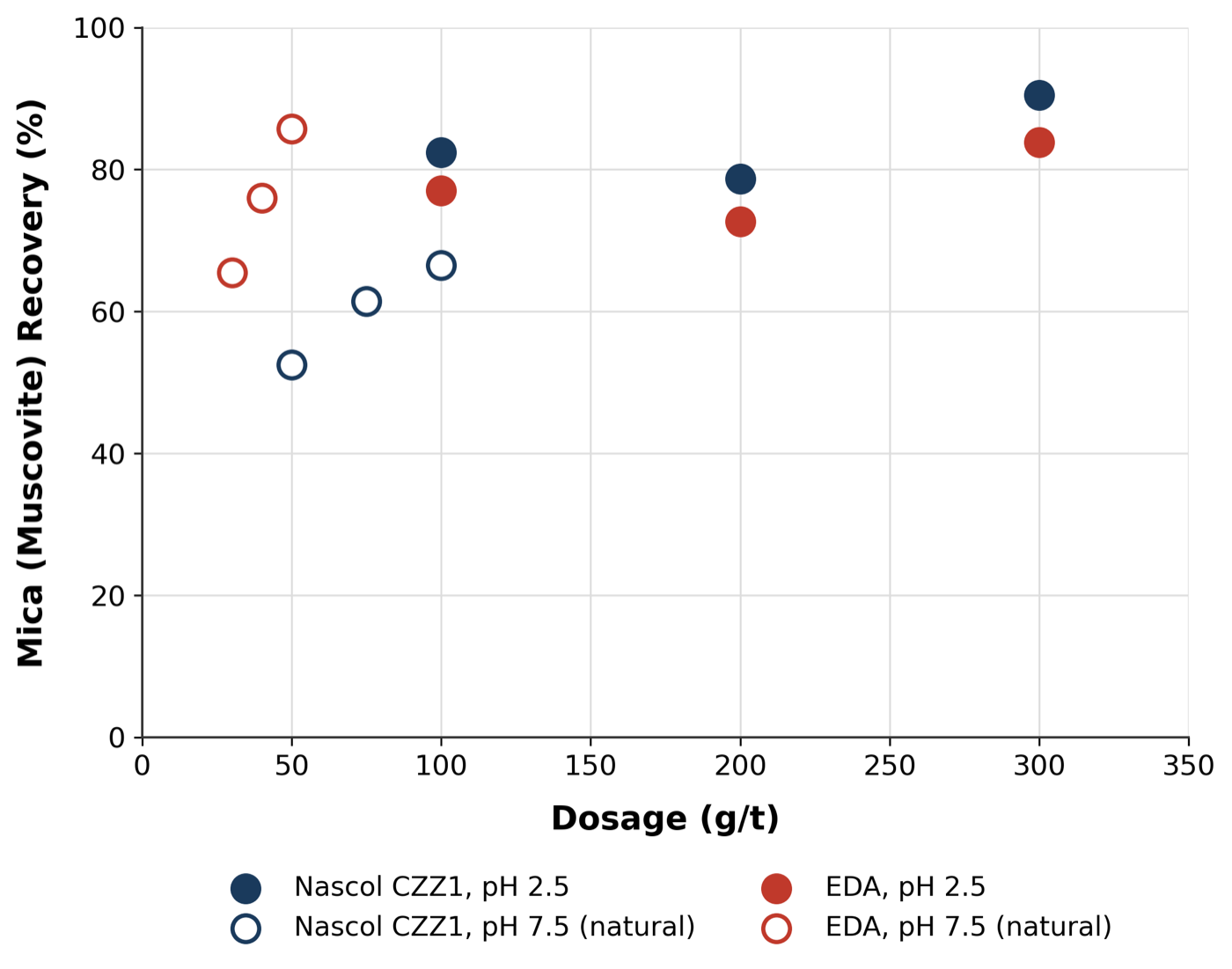
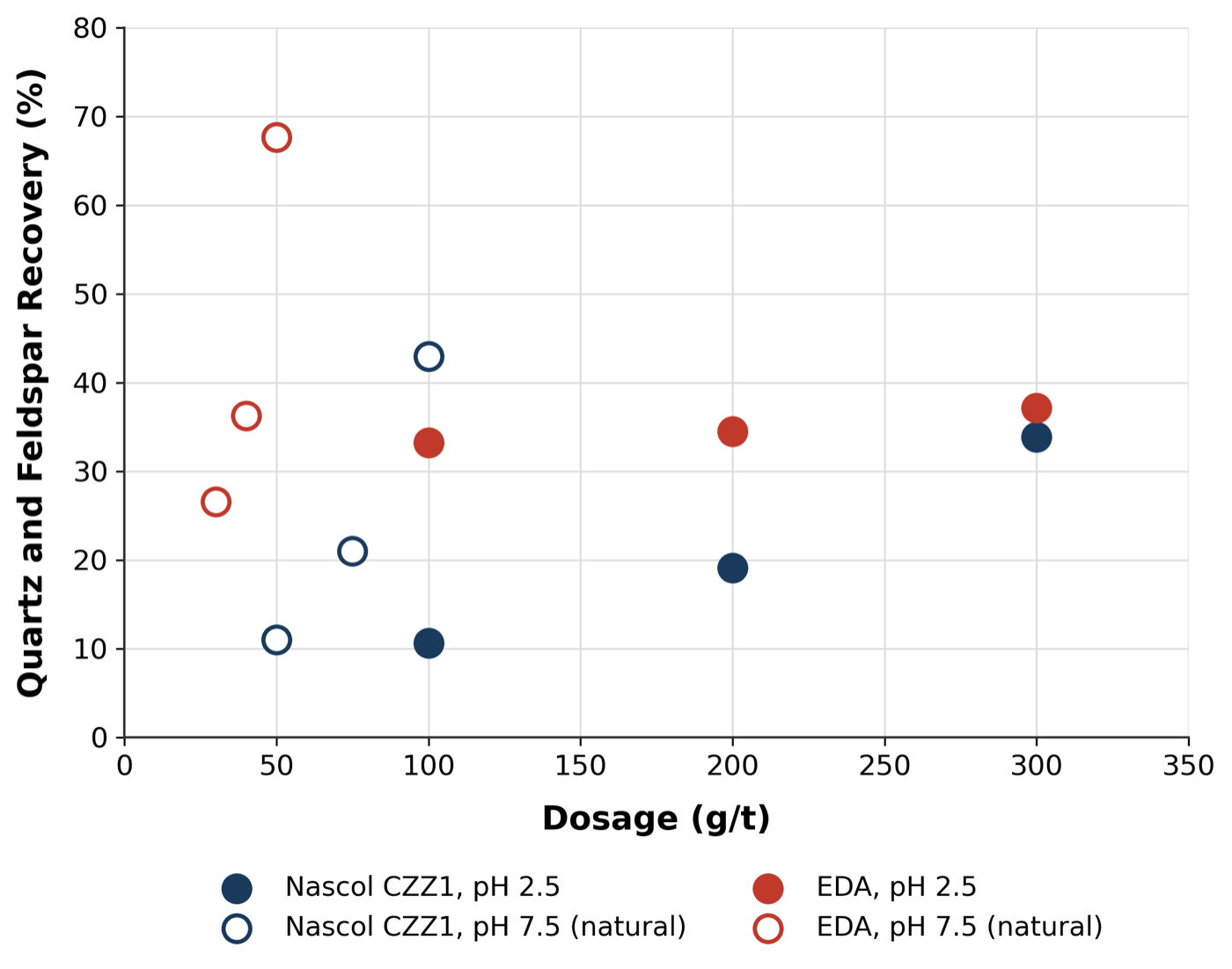
Nascol CZZ1 performed best at pH 2.5. Across dosages of 100–300 g/t, it achieved mica recoveries of 78–90% while limiting quartz and feldspar recovery to 11–34%. This confirms its role as a selective mica collector under acidic conditions. At the same pH it outperformed EDA, which achieved slightly lower mica recovery of 73–84%, alongside higher quartz and feldspar recovery (33–37%) over the same dosage range.
Figure 1: Mica (muscovite) recovery as a function of collector dosage at pH 2.5 and pH 7.5, for Nascol CZZ1 and EDA.Figure 2: Quartz and feldspar recovery as a function of collector dosage at pH 2.5 and pH 7.5, for Nascol CZZ1 and EDA.
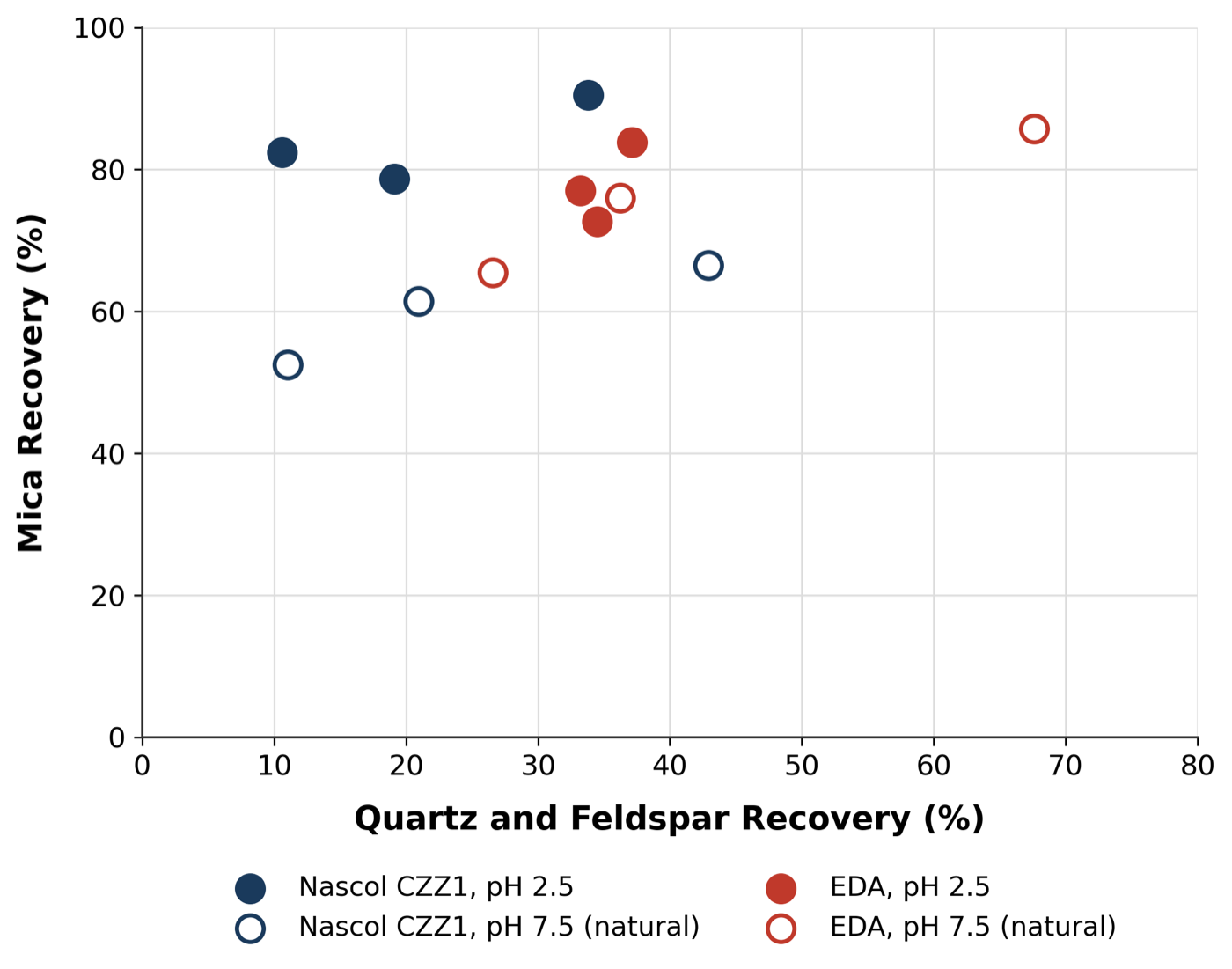
At pH 7.5, the Nascol CZZ1 response shifts closer to the EDA selectivity trend, meaning it no longer shows the same separation advantage (see Figure 3). Selectivity is particularly limited if the dosage is pushed too high. A practical implication is that natural-pH operation should not be treated as a direct dosage-for-dosage replacement for the low-pH condition (Figures 1 and 2). At pH 7.5, considerably lower amine dosages should be used to limit quartz and feldspar recovery.
At lower natural-pH dosages, Nascol CZZ1 can still limit quartz and feldspar recovery, but this comes with approximately 10–20% lower mica recovery. This may be acceptable where reduced acid use, lower caustic demand and lower reagent dosage are the main priorities, but it does not provide mica removal equivalent to the low-pH condition.
Selectivity and spodumene losses
Figure 3: Relationship between quartz and feldspar recovery and mica recovery at pH 2.5 and pH 7.5, for Nascol CZZ1 and EDA.
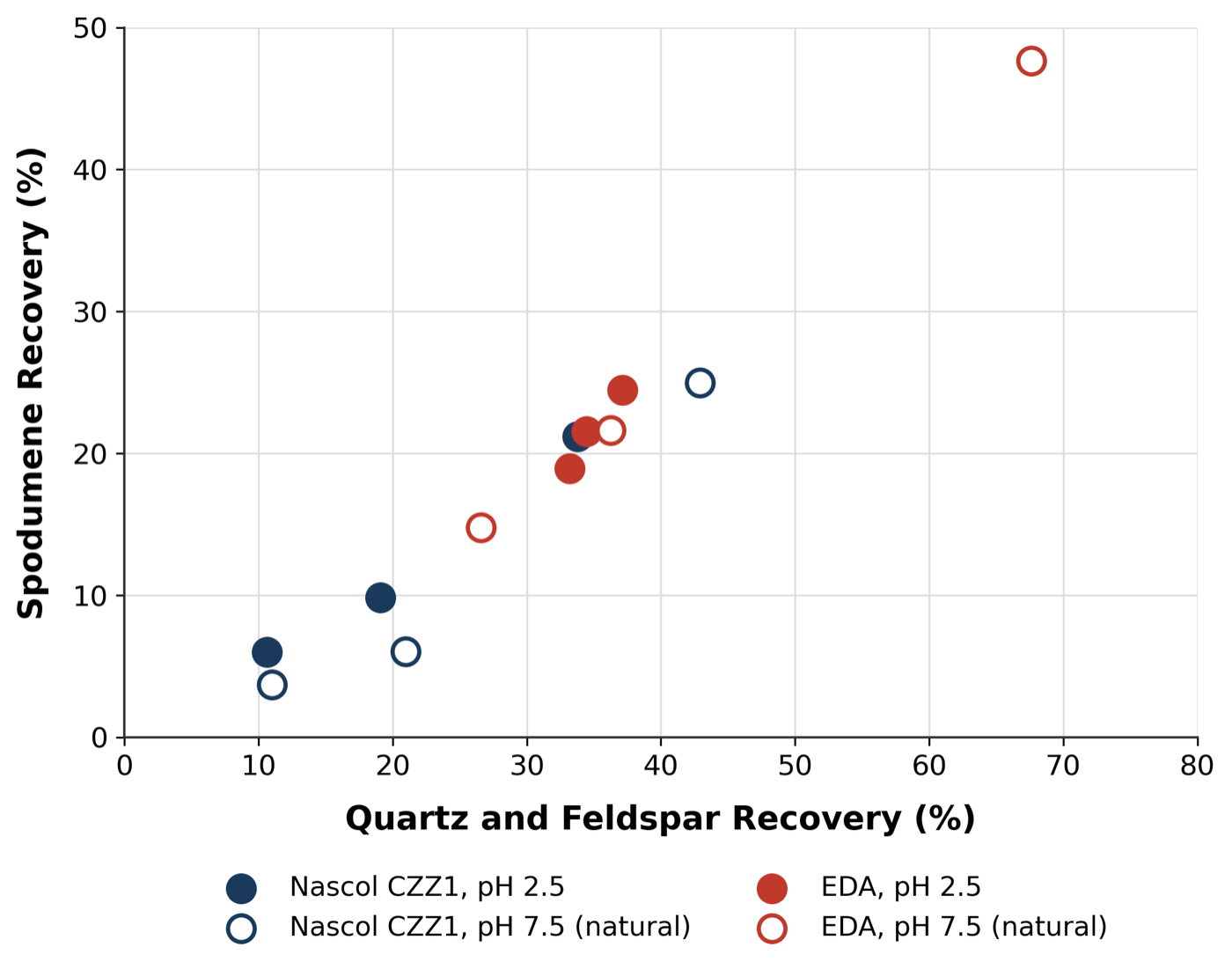
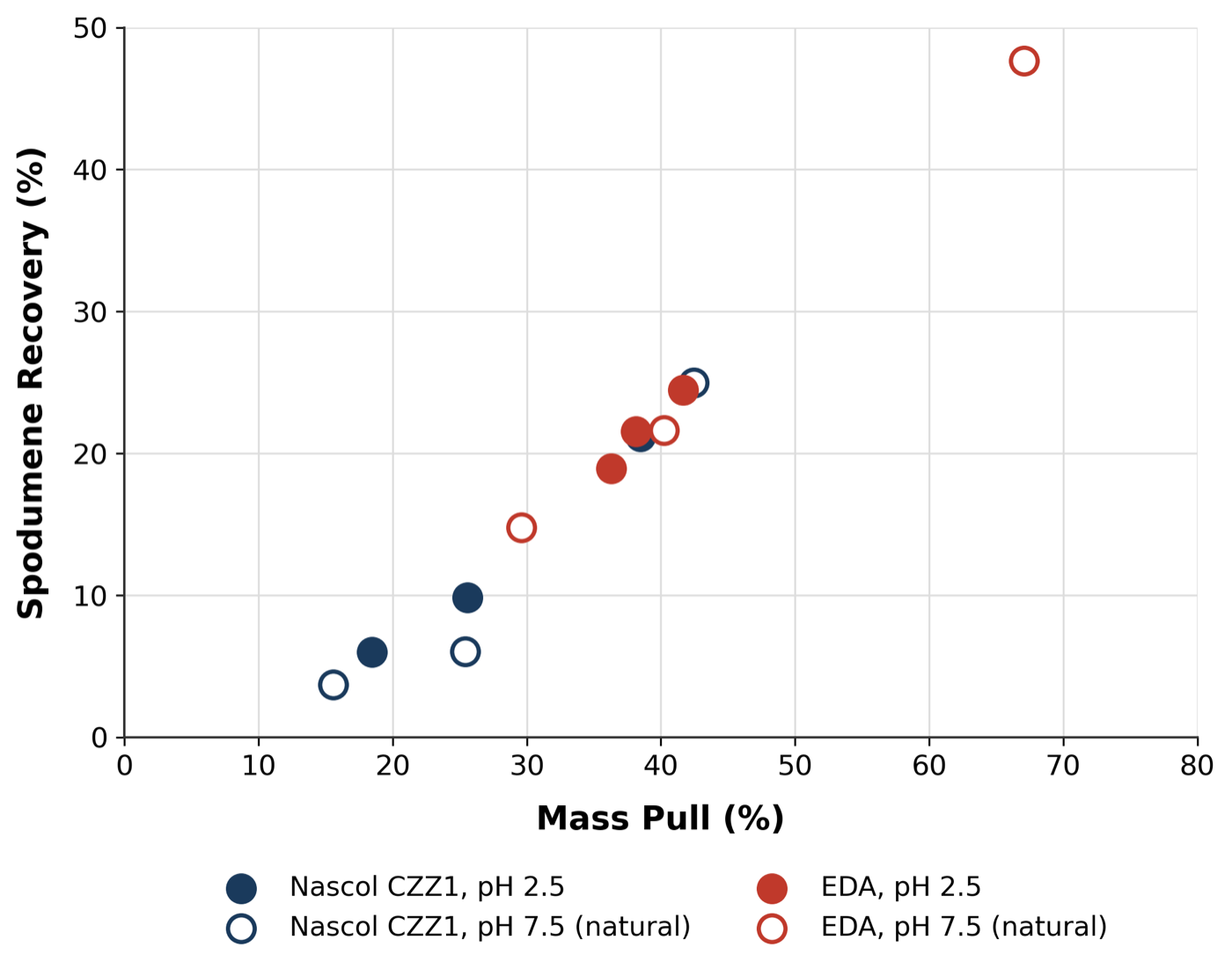
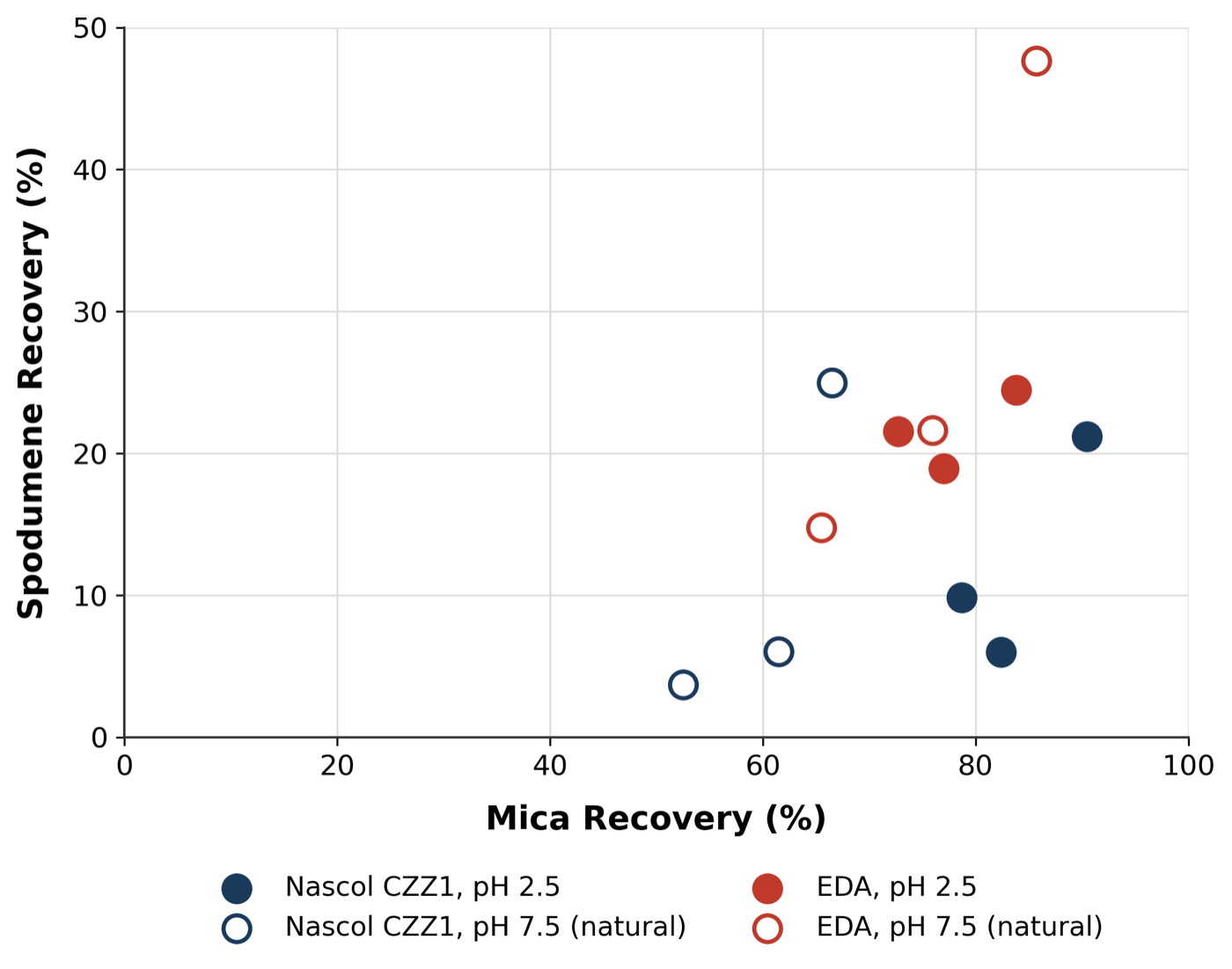
The spodumene recovery data (Figures 4 to 6) support this interpretation. Spodumene recovery to the mica prefloat tracks closely with quartz and feldspar recovery and with mass pull, rather than with mica recovery itself. This indicates that spodumene loss in the prefloat is driven mainly by mass pull, entrainment and entrapment, rather than by true selective flotation of spodumene. Limiting quartz and feldspar recovery is therefore important to limit spodumene losses.
EDA at pH 7.5, particularly at the top of the dosage range tested (50 g/t), produced the highest mass pull (67%) and quartz and feldspar recovery (68%) of any condition in this study, and correspondingly the highest spodumene loss (48%). Nascol CZZ1 at natural pH did not approach these levels of mass pull or spodumene loss within the dosage range tested.
Figure 4: Relationship between spodumene recovery and quartz and feldspar recovery at pH 2.5 and pH 7.5, for Nascol CZZ1 and EDA.Figure 5: Relationship between spodumene recovery and mass pull at pH 2.5 and pH 7.5, for Nascol CZZ1 and EDA.Figure 6: Relationship between spodumene recovery and mica recovery at pH 2.5 and pH 7.5, for Nascol CZZ1 and EDA.
Key takeaway
Nascol CZZ1 is most selective when dosed at pH 2.5, and this remains the benchmark condition for maximum mica rejection with minimum spodumene loss.
At natural pH, its selectivity advantage is reduced and its performance moves closer to that of EDA. For the same mica recovery, more quartz and feldspar are recovered, and spodumene losses are greater as a result. Natural-pH operation may reduce acid and caustic requirements, but it should be paired with substantially lower amine dosages to avoid excessive quartz and feldspar recovery.
The trade-off is simpler pH control and lower reagent dosage, against lower mica recovery and selectivity closer to a conventional amine. For optimum mica removal and minimum spodumene loss, low-pH operation remains the preferred condition.
Improving circuit efficiency through targeted mica recovery. Nasaco test work compares the selective amine collector Nascol CZZ1 with EDA in the mica prefloat ahead of spodumene flotation.
A-SEM data is now regularly used to identify the gangue minerals in flotation concentrates and can be used to focus efforts on their removal. Here, we will discuss how the process can be used to reduce gangue minerals in concentrate streams.